 EN
EN ES
ES AR
AR









_converted.avif)


_converted.avif)


BLOG DETAIL
Node.js ecommerce for Building Flexible and Scalable Online Stores

Raja Moorthy
October 01, 2026 | 56 Views | 2 Min Read
Explore Node.js ecommerce development, open-source platforms, APIs, marketplaces, and how SpurtCommerce supports scalable B2B and B2C commerce.
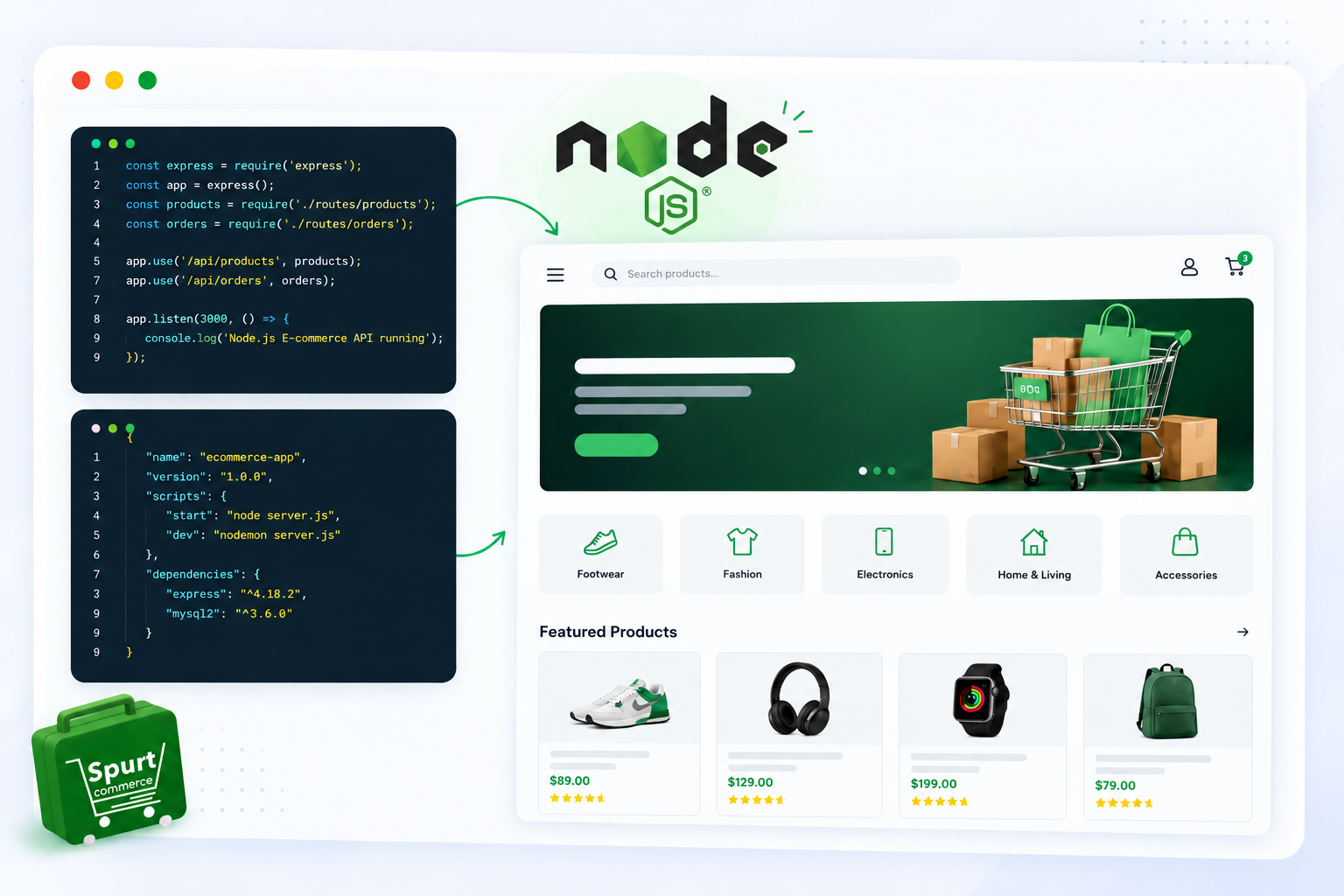
Choosing the right technology foundation is one of the most important decisions when building an ecommerce business.
An ecommerce platform needs to do much more than display products and process orders. As a business grows, it must handle increasing traffic, product catalogs, customers, sellers, transactions, integrations, and increasingly complex business workflows.
This is where Node.js ecommerce development can provide a strong foundation.
Node.js is designed around an event-driven architecture and non-blocking I/O, making it suitable for applications that need to handle many concurrent operations.
For businesses looking for an open and customizable approach to ecommerce, SpurtCommerce combines Node.js with an open source architecture, modern frontend technologies, APIs, and marketplace capabilities.
The result is a technology foundation designed for businesses that want control over their ecommerce platform rather than being limited by a fixed SaaS environment.
What Makes Node.js Relevant for Ecommerce?
Ecommerce applications continuously process different types of requests.
A customer might browse products while another customer is checking out. At the same time, sellers may be updating inventory, administrators may be processing orders, and external systems may be communicating with the platform.
Node.js uses an event-driven, non-blocking architecture that is designed to handle I/O-intensive applications efficiently. Its official documentation describes Node.js as using an event loop and supporting HTTP with a focus on streaming and low latency.
This makes Node.js an attractive technology for modern ecommerce applications where responsiveness and scalability are important considerations.
What Is a Node.js Ecommerce Platform?
A Node.js ecommerce platform is an ecommerce system where the backend or major application services are built using Node.js.
Instead of relying on a traditional server-side technology stack, businesses can use JavaScript-based technologies across different layers of the application.
This approach can provide several practical benefits for development teams:
- Modern JavaScript ecosystem
- API-driven development
- Flexible integrations
- Modular application development
- Large developer ecosystem
- Compatibility with modern frontend frameworks
- Support for real-time and event-driven applications
For businesses building customized ecommerce solutions, these capabilities can make Node.js an interesting foundation.
Why Open Source Matters in Node.js Ecommerce
Technology ownership becomes increasingly important as an ecommerce business grows.
With a closed ecommerce platform, businesses may be restricted by the provider's roadmap, available integrations, customization options, or deployment model.
A Node.js open source ecommerce platform provides a different approach.
Businesses and development teams can access the source code, customize business logic, build integrations, modify workflows, and adapt the platform to their requirements.
SpurtCommerce is positioned as a fully open source ecommerce platform, providing source-code access and customization capabilities for B2B and B2C marketplaces.
This means businesses can have greater control over how their ecommerce technology evolves.
SpurtCommerce: A Node.js Foundation for Ecommerce
Spurtcommerce is an open source ecommerce and marketplace platform built with Node.js and modern technologies.
Its current technology stack includes Node.js, React, Angular, Next.js, MySQL, RabbitMQ, Redis, and other infrastructure technologies.
This technology foundation allows businesses to build different commerce models, including:
- B2C ecommerce
- B2B ecommerce
- Multi-vendor marketplaces
- B2B multi-vendor marketplaces
- B2C multi-vendor marketplaces
- Wholesale ecommerce
- Custom commerce workflows
SpurtCommerce provides dedicated capabilities for administrators, sellers, and storefront users, allowing businesses to manage the different parts of a marketplace ecosystem from a common platform.
Building a Node.js Based Ecommerce Website
A Node.js based ecommerce website doesn't have to be limited to a basic online store.
Modern ecommerce businesses often require much more.
A typical SpurtCommerce implementation can include functionality for:
Product Management
Businesses can manage products, categories, variants, attributes, inventory, pricing, and other catalog information.
Customer Management
Customer profiles, customer groups, orders, and other customer-related operations can be managed through the platform.
Order Management
The platform provides workflows for managing orders and fulfillment activities.
Payment and Shipping
Payment and shipping configuration can be integrated into the commerce workflow.
Vendor Management
For multi-vendor businesses, sellers can manage products, orders, inventory, earnings, and marketplace operations through dedicated seller functionality.
Returns and Refunds
Marketplace operators can manage return requests, approvals, and refunds through structured workflows.
Vendor Settlements
Commission calculations, seller earnings, and settlement processes can be managed as part of the marketplace ecosystem.
This makes SpurtCommerce more than simply a storefront framework. It provides a broader foundation for building and operating ecommerce businesses.
Node.js Ecommerce Framework vs. Ready Ecommerce Platform
There is an important difference between choosing a development framework and choosing an ecommerce platform.
A framework gives developers building blocks.
An ecommerce platform provides business functionality along with the technology foundation.
If a business starts with a framework alone, the development team may need to build major ecommerce capabilities from scratch:
- Product catalog
- Customer management
- Cart
- Checkout
- Orders
- Seller management
- Payments
- Shipping
- Promotions
- Returns
- Settlements
That can significantly increase development time.
SpurtCommerce takes a different approach by providing ready-to-use commerce capabilities alongside its Node.js-based technology foundation.
Its platform includes functionality for vendor onboarding, orders, returns and refunds, shipping, and vendor settlements.
This allows development teams to spend more time on business-specific requirements instead of rebuilding common ecommerce functionality.
Node.js Ecommerce Solutions for Different Business Models
One of the advantages of a flexible ecommerce architecture is that it can support different business models.
SpurtCommerce currently supports both B2B and B2C commerce, including multi-vendor marketplace models.
B2C Ecommerce
Businesses can build online stores focused on direct customer sales, product discovery, checkout, promotions, and order management.
B2B Ecommerce
Businesses can create wholesale and business-focused ecommerce experiences with workflows designed for business buyers.
Multi-Vendor Ecommerce
Businesses can create marketplaces where multiple sellers manage their products and orders while administrators control marketplace operations.
Hybrid Commerce
Organizations can combine different commerce workflows based on their specific business requirements.
This flexibility makes Node.js ecommerce solutions particularly useful when businesses don't want to be restricted to a single commerce model.
API-Driven Ecommerce Development
Modern ecommerce rarely operates as an isolated system.
Businesses often need to connect their ecommerce platform with:
- ERP systems
- CRM platforms
- Payment gateways
- Shipping services
- Accounting systems
- Warehouse management systems
- Marketing platforms
- AI services
- Third-party business applications
SpurtCommerce provides API documentation for integrations, headless commerce implementations, third-party services, and custom development.
An API-driven approach gives developers greater flexibility when connecting ecommerce operations with the rest of the business technology ecosystem.
Frontend Flexibility with Modern Technologies
The backend is only one part of the ecommerce experience.
Customers interact with the storefront, so frontend performance, flexibility, and usability are equally important.
SpurtCommerce supports modern frontend technologies including React, Angular, and Next.js.
The platform's Next.js storefront approach is designed to support performance, SEO, personalization, flexibility, and security considerations.
This gives development teams options when creating customer-facing ecommerce experiences.
Node.js Ecommerce Marketplace Development
A Node.js ecommerce marketplace has additional requirements compared with a traditional single-seller store.
The platform needs to support multiple stakeholders.
Sellers
Sellers need tools for:
- Product management
- Inventory
- Orders
- Promotions
- Earnings
- Shipping
- Seller profiles
Administrators
Marketplace administrators need control over:
- Seller onboarding
- Product management
- Orders
- Customers
- Commissions
- Settlements
- Shipping
- Payments
- Reports
Customers
Customers need:
- Product discovery
- Search and filtering
- Product comparison
- Cart
- Checkout
- Payment
- Order tracking
- Returns and refunds
SpurtCommerce provides separate storefront, seller, and admin capabilities to support these different roles.
Why Developers Can Choose SpurtCommerce
For development teams, one of the major advantages of an open source platform is control.
With SpurtCommerce, developers can access the source code and customize the platform according to project requirements.
The platform describes itself as developer-first, with a modular codebase, API-driven architecture, and full source-code access.
Developers can therefore work on:
- Custom business workflows
- New ecommerce modules
- Third-party integrations
- Custom storefronts
- Marketplace-specific functionality
- Infrastructure changes
- Performance improvements
This is particularly useful for businesses that have requirements beyond standard ecommerce functionality.
Scaling a Node.js Ecommerce Platform
Growth is one of the biggest challenges in ecommerce.
A platform that works for a small catalog and limited traffic may eventually need to support:
- Larger product catalogs
- More customers
- More sellers
- Higher order volumes
- More integrations
- Increased traffic
- Multiple business operations
SpurtCommerce uses technologies such as Redis for caching and RabbitMQ for asynchronous communication and workflow processing, alongside Node.js and database technologies.
The platform also supports self-hosted deployment, giving businesses greater control over infrastructure and scaling decisions.
When Should You Consider Node.js for Ecommerce?
Node.js can be worth considering when your ecommerce project requires:
- High levels of API activity
- Real-time or event-driven functionality
- Modern JavaScript development
- Flexible integrations
- Custom business logic
- Scalable application architecture
- Modern frontend frameworks
- Developer-friendly open source technology
However, the technology choice should always be based on the project's requirements, development team's expertise, infrastructure, and long-term business goals.
The technology itself is only one part of building a successful ecommerce platform.
The architecture and business capabilities built around it matter just as much.
Why Spurtcommerce for Node.js Ecommerce?
SpurtCommerce combines the flexibility of open source with ready-to-use ecommerce and marketplace capabilities.
Instead of starting with a blank Node.js project and building every ecommerce function from the ground up, businesses can begin with an existing commerce foundation and customize it according to their requirements.
Its technology and feature set support:
Node.js + Open Source + APIs + Modern Frontend + Marketplace Workflows
This combination provides a foundation for businesses building B2B, B2C, and multi-vendor ecommerce platforms.
Building the Future of Ecommerce with Node.js
Node.js has become an important technology for modern web application development because of its event-driven architecture, JavaScript ecosystem, and suitability for I/O-intensive applications.
But choosing Node.js is only the beginning.
Businesses also need an ecommerce foundation that provides the functionality, flexibility, integrations, and ownership required for long-term growth.
That's where Spurtcommerce fits.
As a Node.js ecommerce platform, SpurtCommerce provides businesses with an open source foundation for building customized ecommerce websites and marketplaces.
Whether you're planning a Node.js ecommerce solution, a Node.js based ecommerce website, or a full Node.js ecommerce marketplace, the combination of open source access, modern architecture, and ready-to-use commerce capabilities can help reduce development effort while giving businesses greater control over their technology.
Build your ecommerce business on a technology foundation that you can customize, extend, and own.

 Available