 EN
EN ES
ES AR
AR











_converted.avif)


_converted.avif)


BLOG DETAIL
Turning B2B Negotiation into a Scalable Commerce Process

Raja Moorthy
January 02, 2026 | 336 Views | 1 Min Read
Learn how structured RFQ-based negotiation in SpurtCommerce prevents pricing errors, reduces friction, and makes B2B commerce predictable and scalable.
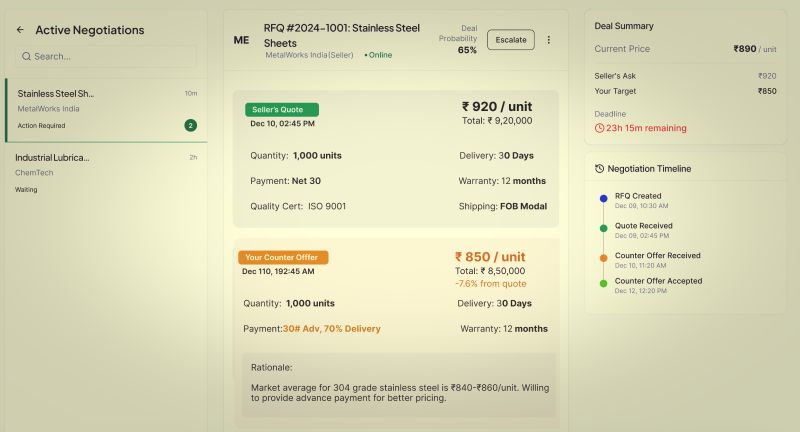
In B2B buying, negotiation doesn’t happen in a single call or email thread.
It unfolds over time, across teams, approvals, revisions, and validations.
Yet many negotiations still live in emails, phone calls, and spreadsheets.
And that’s where things break.
At SpurtCommerce, we’ve observed that negotiations often fail not because buyers and sellers disagree, but because the process lacks structure. Context gets lost, pricing changes unintentionally, and approved terms don’t carry forward into the order.
Where Unstructured Negotiation Fails
- When negotiation happens outside the platform:
- RFQs are vague and incomplete
- Offers are scattered across messages
- Pricing versions are unclear
- Validity periods are forgotten
- Approved terms don’t match checkout values
This leads to rework, confusion, and delays, especially in enterprise procurement.
What Changes When Negotiation Is Structured
When negotiation is built directly into the commerce platform, everything becomes clearer and more controlled:
- Buyers submit clear, structured RFQs, not informal requests
- Sellers respond with traceable offers, not fragmented replies
- Pricing, quantities, and validity periods are visible to all stakeholders
- Once approved, terms flow directly into orders, with no re-entry or mismatch
Negotiation becomes a defined workflow, not a series of disconnected conversations
How SpurtCommerce Enables Structured B2B Negotiation
SpurtCommerce embeds negotiation directly into the B2B buying journey with purpose-built capabilities:
- RFQ-based negotiation workflows
- Buyer-specific or contract-specific pricing
- Versioned offers with defined validity periods
- Approved prices automatically applied at checkout
This ensures that what is negotiated is exactly what gets ordered.
What SpurtCommerce Has Observed in Real B2B Operations
By moving negotiation into the platform, businesses experience measurable improvements:
- Faster alignment between sales and procurement teams
- Fewer misunderstandings after approvals
- Clean audit trails for enterprise buyers
- Deals that close smoothly, without friction or rework
Most importantly, negotiations no longer restart at checkout, and pricing doesn’t change by mistake.
Predictable Negotiation Enables Scalable B2B Commerce
In B2B, scale comes from repeatability and control.
When negotiation is structured, transparent, and enforced by the platform:
- Processes become predictable
- Compliance improves
- Enterprise trust increases
- Growth becomes sustainable
Negotiation shouldn’t slow commerce down.
It should enable it.
Conclusion
Negotiation is not just a conversation, it’s a process that needs structure.
By embedding RFQs, pricing control, and approval workflows directly into the platform, SpurtCommerce turns negotiation into a scalable, predictable part of B2B commerce.
When negotiation lives inside the system, deals move faster, errors disappear, and businesses scale with confidence.

 Disponible